
Here is the number that should reframe how you think about remote hiring: across 19,368 live interviews tracked between July 2025 and January 2026, 38.5% of candidates were flagged for AI-cheating behavior — and 61% of those cheaters still scored above the pass threshold. Read that twice. The problem is not just that people cheat. It is that cheating works, and your existing scorecards wave it through.
This guide is the calm version of that conversation. Not "the robots are coming," but a practical playbook for keeping your remote interviews honest without turning them into surveillance. We will define what interview integrity actually means now, map the threat, give you a framework you can run this quarter, and be honest about the part most vendors skip: fairness, false positives, and the honest candidate who deserves not to be accused.
Contents
- What interview integrity means in the AI era
- The threat landscape: tools and prevalence
- A working framework: deter, detect, decide
- Fairness and the candidate experience
- Consent and legal basics
- How to choose tooling
- Frequently asked questions
What interview integrity means in the AI era
Interview integrity is a simple promise: the person you evaluate is the person you hire, and the answers you score reflect what that person can actually do. For years that promise mostly held on its own. A remote interview over Zoom was a decent proxy for the real thing.
AI broke the proxy. A candidate can now sit in a video call looking attentive while a hidden assistant reads the question, drafts a polished answer, and displays it in a place your screen share will never catch. The words are fluent, the structure is textbook, and none of it is theirs. Integrity in 2026 is no longer about whether someone Googled a term. It is about whether an AI system is quietly sitting in the chair with them.
It helps to separate three failures that often get lumped together:
- Assistance fraud — a real candidate uses a hidden AI tool to answer questions they could not answer alone.
- Identity fraud — the person on camera is not the person who applied, or does not exist at all. Gartner predicts that by 2028, one in four candidate profiles worldwide could be fake.
- Misrepresentation — inflated resumes, fabricated references, and AI-polished work samples that overstate real ability.
This guide focuses on the first, with an eye on the second, because that is where live remote interviews are most exposed. And it is worth being precise: the goal of interview integrity is not to catch people. It is to make your evaluation mean something again, so that the honest candidate who prepared and can do the work is the one who wins.
The threat landscape: tools and prevalence
The uncomfortable truth is that "ask them to share their screen" stopped being a safety net. The current generation of interview-assistance tools is built specifically to stay invisible during a screen share, using click-through overlays and audio transcription that never appear in the shared window or the recording.
The prevalence data has moved fast:
- In that same analysis of nearly 20,000 interviews, cheating tripled between July and September 2025 — this is not a slow trend line.
- A 2026 Resume Genius survey of 1,000 U.S. job seekers found 22% have used AI in real time during a live interview.
- An April 2025 Blind survey of more than 3,600 professionals found one in five secretly used AI in a job interview, and 55% called it "the new norm".
The methods break down more predictably than you might expect. In the interview analysis, dedicated assistants like Cluely and Interview Coder accounted for 45% of cheating cases, voice mode on LLMs like ChatGPT for 34%, old-fashioned tab-switching or a second screen for 18%, and a live human helper for just 3%. Two things follow. First, most cheating is now software, not a person off-camera — which is why "look for someone reading" is a weak defense. Second, exposure is not uniform: technical roles showed a 48% cheating rate versus 12% for sales. If you hire engineers, you are the target.
The most cited of these tools bills itself as undetectable, which tells you the market has professionalized. If you want the mechanics of one, we broke down how to detect Cluely in interviews separately. The point here is that the human eye alone is a shrinking advantage, and the interviewers know it: in one survey 59% of managers suspect candidates of misrepresenting themselves with AI, but only 19% are confident their process would actually catch it. That gap — between suspicion and proof — is the whole job.
A working framework: deter, detect, decide
Most advice on this topic is a pile of tips. Tips do not scale across a hiring team. What scales is a framework you can write into a process and train interviewers on. We use three stages: deter, detect, decide. Each one does a different job, and skipping any of them is where teams get burned.
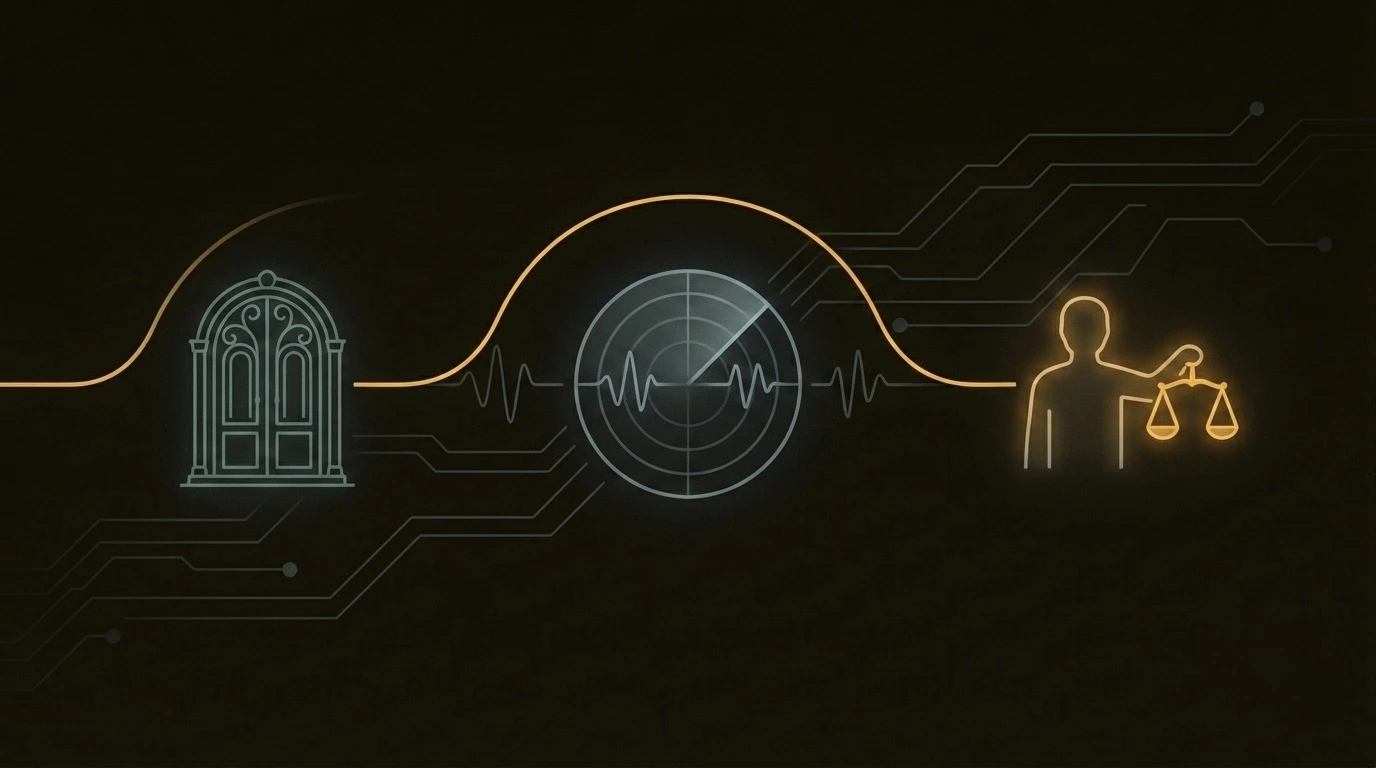
Deter — make honesty the easy path
The cheapest integrity win is the one that happens before the interview starts. Deterrence is not a threat; it is clarity.
- State the policy up front. Tell candidates, in writing, that live interviews are for their own work and that AI assistance tools are not permitted during the conversation. Most honest people simply comply when the line is clear.
- Design questions AI is bad at. Ask for specific stories, exact numbers on a project they listed, and opinions with no clean right answer. AI has no memories; it cannot invent the name of the person in a real conflict story. Our guide to a fair interview process goes deeper on question design.
- Tell candidates if you use detection tooling — and why. Disclosure is not just ethical, it is a deterrent. A candidate who knows structural signals are being read is far less likely to try.
Deterrence alone will not stop a determined cheater. But it shrinks the problem to the people who are actually trying to game you, which is exactly who your detection layer should be spending its attention on.
Detect — read signals, not vibes
Detection is where gut feeling has to give way to evidence. A skilled interviewer notices eyes drifting off-camera, a consistent three-to-five-second pause before a suddenly complete answer, or a flat reading cadence. Those tells are real, but they are also easy to misread — plenty of thoughtful, nervous, or neurodivergent candidates pause and look away. That is why detection should tie a small set of objective signals to the exact moment they happen, rather than asking one interviewer to hold a hunch in their head.
The signals worth reading during a live remote interview:
- App and screen context — whether a hidden overlay or assistant is active on the candidate's machine.
- Keystroke and paste behavior — a wall of text pasted in one motion reads very differently from typed-out thinking.
- Voice and answer structure — reading cadence and the templated scaffolding of a generated answer.
This is the layer where tooling earns its place. A tool like Trueyy sits beside Zoom, Google Meet, or Microsoft Teams and reads device-level signals from the candidate's machine in real time, with consent, scoring risk roughly every 30 seconds across apps and screen, keystrokes and paste, and voice. It recognizes ChatGPT, Claude, Gemini, Copilot, Cluely, Interview Coder and 50-plus tools through structural output signatures rather than a keyword list, so a renamed app does not slip through. You can see the signals it reads on the features page and how it fits into a call on the how-it-works page. What it deliberately does not do is lock down the candidate's browser, force a heavy install, or record video — because integrity should not require treating every applicant like a suspect.
Decide — keep a human in the loop
This is the stage teams most often get wrong, and it is the one with the highest stakes. A detection signal is not a verdict. It is a prompt to look closer.
No automated system should reject a candidate on its own. The EEOC is explicit that "anti-discrimination laws still apply" to AI-driven hiring tools, and that employers remain responsible for outcomes. A risk score is one input among several. The interviewer, and ideally a second reviewer, weighs it against the whole conversation: Did the candidate go deep when pushed off-script? Do the specifics hold up? Is there an innocent explanation for the signal?
Write this into your process explicitly. A high risk score triggers a review — a follow-up question, a second interviewer, a structured re-check — never an automatic rejection. Learning to read an integrity report as a timeline of moments, not a single number, is the skill that keeps this fair.
Fairness and the candidate experience
If you take one thing from this guide, take this: an integrity program that produces false accusations is worse than no program at all. It punishes honest people, poisons your employer brand, and exposes you to legal risk — all while the sophisticated cheaters you were worried about adapt and move on.
Candidates already feel the imbalance. In a 2026 Greenhouse survey of 2,950 job seekers, 63% had been interviewed by AI, but 70% were never clearly informed upfront that AI would evaluate them. Employers are quick to demand transparency from candidates while offering little in return. That double standard is a trust problem, and it shows: 57% of those job seekers believe AI disclosure in hiring should be legally mandated.
A fair program follows a few rules:
- No single signal is proof. A pause, an off-camera glance, or one flagged moment is a reason to ask another question, not to reject.
- Disclose what you monitor. Tell candidates before the call what is being read and why. Honest people relax; that is the point.
- Watch for benign explanations. A second monitor for accessibility, a slow connection, a habit of pasting notes they wrote themselves — all of these can trip a naive detector. Good tooling and a human reviewer separate them from real cheating.
- Protect data proportionately. Do not collect more than you need, and be clear about what is kept.
Getting this right is not a compliance chore. It is a competitive advantage. Candidates notice when a company is straight with them, and the honest specialists you actually want to hire are the ones most reassured by a process that is both rigorous and respectful.
Consent and legal basics
Interview monitoring lives inside real law — employment, privacy, and data protection — and the specifics vary by jurisdiction. This is a starting map, not legal advice; run your program past counsel.
The load-bearing principles:
- Consent first. Get clear, informed, opt-in consent before you read any signals from a candidate's machine. Consent that is buried or coerced is not consent.
- Anti-discrimination law still governs the outcome. As the EEOC has made clear, AI tools do not get a pass on civil-rights law; a tool that produces disparate impact is your liability even if a vendor built it. This is another reason a human makes the final call.
- Data minimization and retention. Capture only what the integrity check needs, encrypt it, and retain it under a stated policy. Trueyy, for instance, records no video on its servers; interview audio is transcribed and screenshots are captured, encrypted, and retained per policy — not hoarded indefinitely.
- No biometric identification. Reading whether an AI tool is active is a different thing from identifying a person by their face or voiceprint, which triggers a stricter and growing body of biometric law.
We keep the detailed privacy and data-protection walkthrough in a dedicated resource rather than duplicating it here; for the mechanics of consent-first monitoring, start with the privacy line discussion. The short version: if your program cannot pass a candidate reading exactly what you do with their data, it is not ready.
How to choose tooling
Not every integrity problem needs a product, but past a certain volume, a human eye cannot keep up with software-based cheating. If you are evaluating tools, judge them against the framework above rather than a feature checklist. Questions worth asking:
- Is it built for live interviews or timed tests? Lockdown browsers and remote proctoring were designed for exams. A live conversation over Zoom is a different problem; do not buy an exam tool to solve it.
- Does it detect by structure or by keyword? Keyword and process-name lists break the moment a tool is renamed. Structural output signatures survive it. Ask how the vendor handles a tool they have never seen.
- What does it demand from the candidate? Heavy installs, full browser lockdown, and always-on webcam recording carry a real fairness and privacy cost. Prefer the lightest touch that still reads the signals that matter.
- Where does the human sit? If a tool can auto-reject, walk away. The right tool scores risk and routes it to a person; it does not decide.
- Is consent and data handling built in, or bolted on? Consent flows, encryption, retention limits, and "no biometric ID" should be defaults, not upsells.
- Can you explain a flag to the candidate? If the tool cannot show you why it raised a signal, you cannot defend the decision — to the candidate or to a court.
A quick reality check before you spend: some of what you need is process, not procurement. Clear policy, better questions, and a two-reviewer decision rule cost nothing and close a surprising amount of the gap. Tooling is what you add when the volume and the stakes justify reading signals no interviewer can catch by eye. When you get there, book a demo and pressure-test it against your own funnel before you commit.
Frequently asked questions
What is remote interview integrity?
Remote interview integrity is the assurance that a candidate's answers in a live remote interview reflect their own ability, and that the person on camera is who they claim to be. In practice it combines deterrence (clear policy and AI-resistant questions), detection (reading real-time signals for hidden AI assistance), and a human-led decision. The goal is a fair, meaningful evaluation, not surveillance.
Is it legal to monitor candidates for AI use during an interview?
Generally yes, if you do it with clear, informed consent and handle data proportionately, but the rules vary by jurisdiction and role. Anti-discrimination law still applies to any tool that influences the outcome, so a human should always make the final call. Get consent up front, minimize and secure the data you collect, and have employment counsel review your specific program.
Can you really detect ChatGPT or Cluely during a live interview?
You can detect the signals they produce. Tools that read device-level context, paste behavior, and answer structure in real time can flag when a hidden assistant is active, even when it stays invisible to a screen share. Detecting by structural signatures rather than app names matters, because the tools rename themselves to evade keyword lists — which is how modern detection catches tools like Cluely.
How do you avoid falsely accusing an honest candidate?
Treat every signal as a prompt to look closer, never as a verdict. No single pause, glance, or flag should end a candidacy; a high risk score should trigger a follow-up question or a second reviewer instead. Disclose what you monitor, account for benign explanations like accessibility tools or a slow connection, and keep a human in the loop on every decision.
Should we just go back to in-person interviews?
For some final rounds, an in-person or verified live stage is a reasonable safeguard, especially for high-trust roles. But abandoning remote interviewing entirely throws away access to a wider, often better candidate pool to solve a problem that consent-first detection and good process can handle. Most teams get further by making remote interviews harder to game than by scrapping them.
Where to start
You do not need to solve interview integrity all at once. Start with deterrence you can ship this week: a written AI policy, sharper questions, and a two-reviewer rule so no one is rejected on a hunch or a single score. Add detection when your volume outpaces what interviewers can catch by eye — and when you do, hold it to the standard in this guide: consent-first, structural not keyword-based, and always with a human making the call.
If you want to see what real-time, consent-first detection looks like beside your own interviews, book a demo and bring a hard case. The honest candidates you want to hire are the ones a fair process protects.